
Introduction
Machine learning is one of the most important technologies shaping the modern digital world. From recommendation systems on streaming platforms to fraud detection in banking, machine learning is everywhere. It allows computers to learn from data and improve their performance without being explicitly programmed. This makes it a powerful tool for solving complex real-world problems.
In simple terms, machine learning is a branch of artificial intelligence that focuses on building systems that can learn patterns from data. These systems then use those patterns to make predictions or decisions. For beginners, machine learning may seem complicated at first, but once you understand the core concepts, it becomes much easier to grasp.
Today, industries such as healthcare, finance, marketing, transportation, and education rely heavily on machine learning. Businesses use it to analyze customer behavior, predict trends, and improve decision-making processes. As the amount of data in the world continues to grow, machine learning becomes even more valuable.
What is Machine Learning?
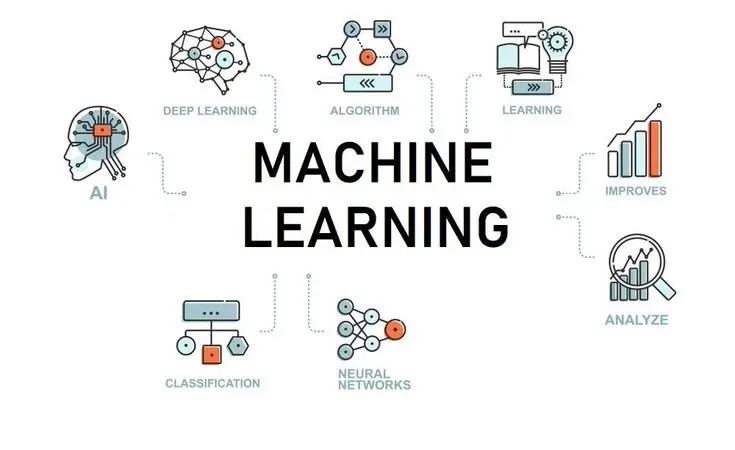
Machine learning is a field of computer science that enables systems to learn from data and improve over time without being explicitly programmed for every task. Instead of writing fixed rules, developers train algorithms using large datasets so the system can identify patterns and make decisions.
Machine learning is a core part of artificial intelligence and focuses on data-driven learning. It uses mathematical models and statistical techniques to help machines understand relationships in data.
There are three main types of machine learning:
- Supervised Learning: The model is trained using labeled data. It learns the relationship between input and output.
- Unsupervised Learning: The model works with unlabeled data and tries to find hidden patterns.
- Reinforcement Learning: The model learns through trial and error using rewards and penalties.
Each type of machine learning serves different purposes and is used in various industries. For example, supervised learning is used in email spam detection, while unsupervised learning is used in customer segmentation.
Machine learning systems improve automatically as they are exposed to more data. This ability to learn and adapt makes them highly effective for solving complex problems that traditional programming cannot handle easily.
Why is Machine Learning Important?
Machine learning is important because it helps computers analyze large amounts of data quickly and accurately. In today’s world, data is generated at an extremely fast rate, and humans alone cannot process it efficiently.
One of the biggest advantages of machine learning is automation. It reduces the need for manual work by allowing systems to make decisions automatically. For example, recommendation engines on platforms like YouTube and Netflix suggest content based on user behavior.
Another important reason is accuracy. Machine learning models can identify patterns that humans may miss. This is especially useful in fields like healthcare, where early disease detection can save lives.
Machine learning also improves decision-making. Businesses use it to analyze customer data, predict market trends, and optimize operations. This leads to better strategies and higher profits.
Additionally, machine learning is essential for innovation. Technologies such as self-driving cars, voice assistants, and smart devices depend heavily on machine learning algorithms.
In short, machine learning is important because it increases efficiency, improves accuracy, enables automation, and drives innovation across multiple industries.
Detailed Step-by-Step Guide
Step 1: Understanding the Problem
The first step in machine learning is clearly defining the problem you want to solve. This could be prediction, classification, or clustering.
Step 2: Collecting Data
Data is the foundation of machine learning. You need to gather relevant and high-quality data from reliable sources. The better the data, the better the model performance.
Step 3: Data Preparation
Raw data is often messy. It must be cleaned, formatted, and processed before training the model. This includes handling missing values and removing duplicates.
Step 4: Choosing the Right Algorithm
Different problems require different algorithms. For example, linear regression is used for prediction, while decision trees are used for classification.
Step 5: Training the Model
In this step, the algorithm learns from the training data. It identifies patterns and relationships between variables.
Step 6: Testing the Model
After training, the model is tested using unseen data to evaluate its performance and accuracy.
Step 7: Improving the Model
If the performance is not satisfactory, adjustments are made. This may include tuning parameters or using a different algorithm.
Step 8: Deployment
Once the model performs well, it is deployed into a real-world environment where it can start making predictions or decisions.
Benefits of Machine Learning

- Improves accuracy in predictions and decisions
- Saves time through automation of tasks
- Handles large datasets efficiently
- Enhances customer experience through personalization
- Helps in fraud detection and security systems
- Supports medical diagnosis and healthcare improvements
- Reduces operational costs for businesses
- Enables advanced technologies like AI assistants and self-driving systems
Disadvantages / Risks
- Requires large amounts of data
- High computational cost and resources needed
- Can produce biased results if data is biased
- Complex to understand and implement for beginners
- Lack of transparency in some models (black box problem)
- Risk of overfitting or underfitting
- Security and privacy concerns with sensitive data
Common Mistakes to Avoid
One common mistake is using poor-quality data. If the data is inaccurate, the model will also produce incorrect results. Another mistake is ignoring data preprocessing, which is a crucial step in building effective models.
Beginners often choose overly complex algorithms without understanding the problem. This can lead to poor performance and confusion. It is always better to start simple and gradually increase complexity.
Overfitting is another major issue where the model performs well on training data but fails on new data. To avoid this, proper validation techniques should be used.
Many people also skip model evaluation, which is a critical step in ensuring reliability. Without evaluation, you cannot trust the model’s performance.
Finally, not updating the model regularly is a mistake. Machine learning models need continuous improvement as new data becomes available.
FAQs
1. What is machine learning in simple words?
Machine learning is a technology that allows computers to learn from data and make decisions without being explicitly programmed.
2. Is machine learning difficult to learn?
It can be challenging at first, but with practice and proper understanding of basics, it becomes easier over time.
3. What skills are needed for machine learning?
Basic programming, mathematics (especially statistics and linear algebra), and understanding of data analysis are important skills.
4. Where is machine learning used?
It is used in healthcare, finance, marketing, social media, transportation, and many other industries.
5. What is the difference between AI and machine learning?
Artificial intelligence is the broader concept, while machine learning is a subset that focuses on learning from data.
6. Can machine learning work without data?
No, machine learning depends completely on data to learn patterns and make predictions.
7. What are the types of machine learning?
The main types are supervised learning, unsupervised learning, and reinforcement learning.
Expert Tips & Bonus Points
Start with simple algorithms before moving to advanced models. Focus on understanding data rather than just coding models. Practice with real datasets to gain practical experience. Always clean and preprocess your data properly before training. Keep learning mathematical concepts behind algorithms for deeper understanding. Use visualization tools to better understand data patterns. Experiment with different models to see what works best for your problem. Stay updated with new trends in machine learning as the field evolves quickly.
Conclusion
Machine learning has become one of the most powerful technologies in the modern world. It is transforming industries by enabling systems to learn from data and make intelligent decisions. From simple recommendation systems to advanced self-driving cars, machine learning is driving innovation everywhere.
For beginners, learning machine learning may seem difficult, but with consistent practice and the right approach, it becomes manageable and highly rewarding. Understanding data, algorithms, and model training is the key to success in this field.
As technology continues to grow, machine learning will play an even bigger role in shaping the future. Businesses, developers, and researchers are constantly finding new ways to use it for solving real-world problems.